Entry046
Up the Canebière
A walk from the Vieux-Port to the Réformés, with the avenue’s hemp name, carved stone fronts, old parade route and trams returning in 2007.
- Place
- La Canebière
- Arrondissement
- 1st
- From the Quai des Belges
- starts at the quay
 Photograph: Chabe01 — CC-BY-SA-4.0
1. “Canebe” at the quay
The name comes before the buildings. ‘Canebe’ is the Provençal word for hemp, and La Canebière takes its name from the rope-walks that once stood here. The avenue begins at the head of the Vieux-Port and runs east for about a kilometre, to the church of Saint-Vincent-de-Paul. A direct line on the map; a longer record in the name.
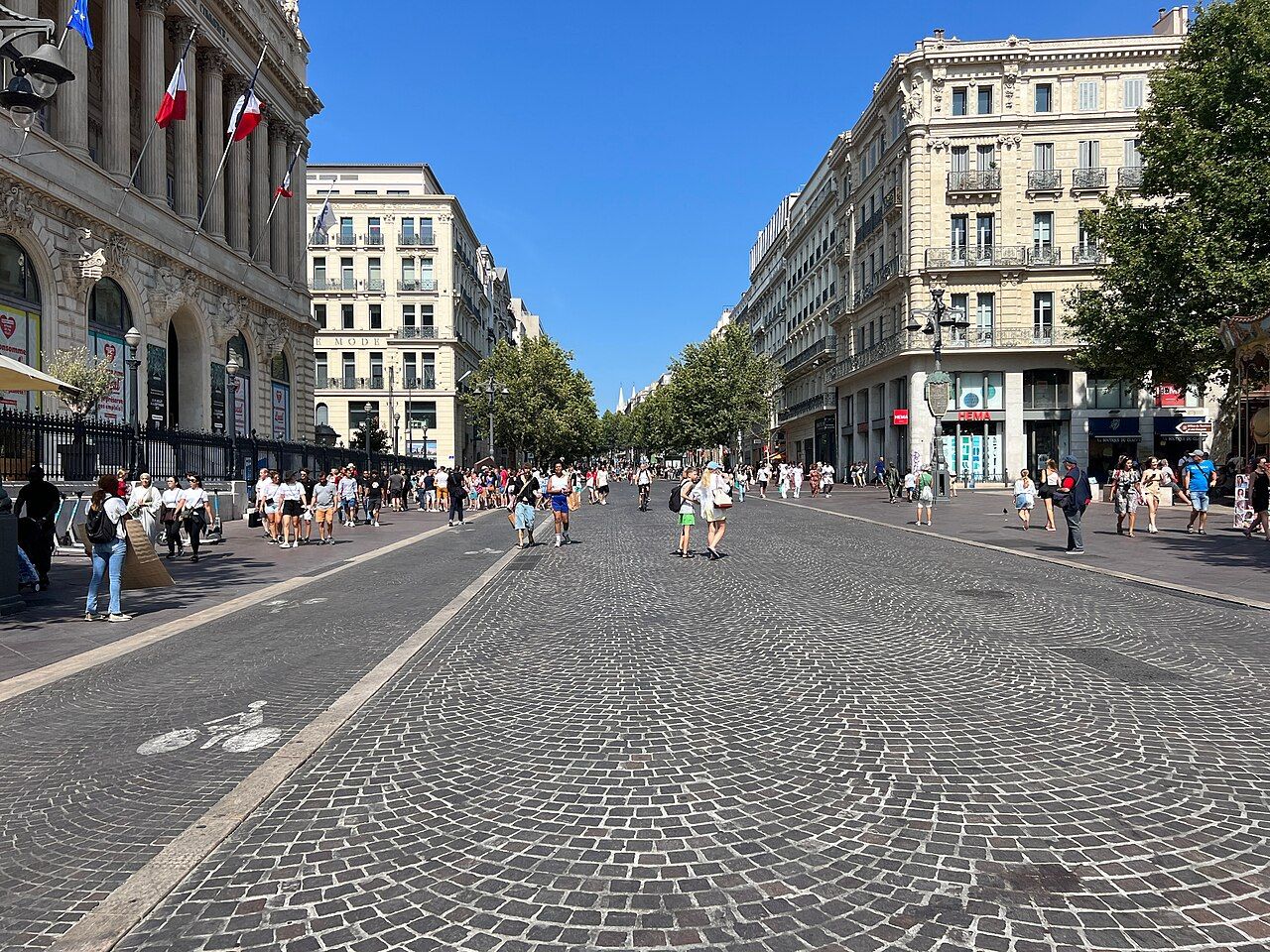
It starts at the quay, where the harbour gives way to the city street. The first stretch is the lower Canebière, lined with large nineteenth-century buildings whose carved stone facades hold the eye. I find it useful to begin with the name, then look at the surfaces: the avenue is a route, and a place shaped by work and ceremony.
2. Laid out after an enlargement
La Canebière was laid out after Louis XIV enlarged the city in the 1660s. That places its beginning in a period of expansion, but the avenue’s later identity is written in separate layers. The rope-walks belong to the name; the large buildings belong to the nineteenth century; the trams belong to a return in the present-day life of the street.
It is tempting to read a straight avenue as one clear statement. Here, the better approach is to take it in sections. The lower Canebière gives the strongest impression of the carved stone fronts. Further along, the route meets the Cours Saint-Louis, then continues towards the church at the top.
3. Stone fronts and the Bourse
The Palais de la Bourse stands on the Canebière. It was built between 1852 and 1860 for the Chamber of Commerce. A useful point to pause at in the avenue’s long sequence: the building gives a specific date range and purpose to the grander nineteenth-century street. The carved facades nearby make the lower stretch feel built for more than simply getting from the harbour to the upper end.
The Canebière holds several uses, not a single monument.
The Canebière holds several uses, not a single monument.
That distinction helps keep the walk grounded. There is the working history in the name, the civic purpose represented by the Palais de la Bourse, and the everyday movement of people along the avenue. The buildings do not need to stand apart from the route to be noticed; they are part of the route’s character.
 Photograph: IngolfBLN — CC-BY-SA-2.0
4. A line between quarters
La Canebière separates Belsunce to the north from Noailles to the south. The avenue is therefore both a destination in its own right and a boundary between neighbouring parts of the city. It is worth keeping that north-and-south division in mind while walking, rather than treating the street as a corridor with nothing on either side.
Belsunce is to the north; the library behind an old music-hall front is a point of reference on that side. Noailles is on the south.
The city's tourist office has its main desk on the Canebière, close to the Vieux-Port. That puts a practical point of reference near the harbour end, before the route begins to stretch east. It is one of the ways the avenue still functions as a central address, as well as a historic one.
5. The Cours Saint-Louis
At the lower Canebière, the Cours Saint-Louis was once lined with flower sellers’ stalls. The detail changes the pace of the walk in the mind: not only a grand avenue and its stone buildings, but a place where stalls once occupied part of the lower stretch.
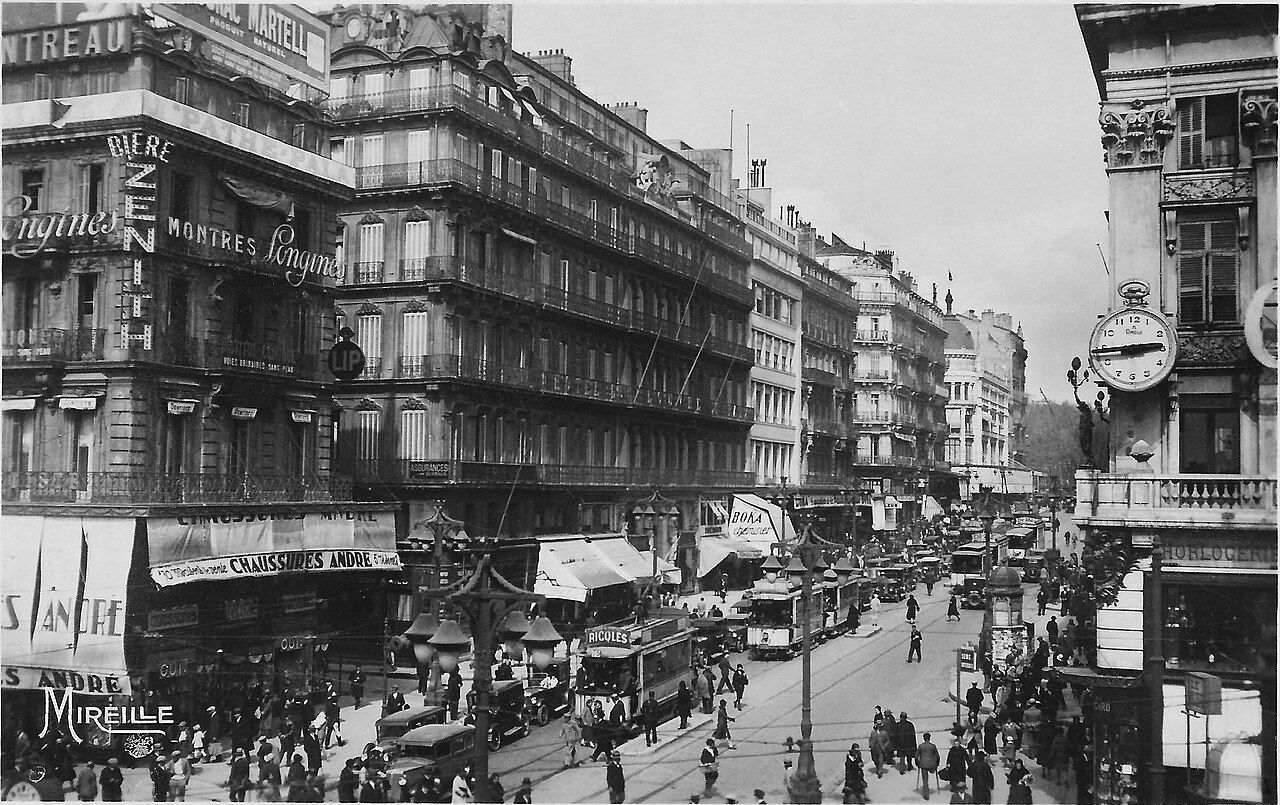
The avenue has long been the route of the city’s parades and processions. This history sits neatly beside the Cours Saint-Louis and its flower sellers. Both point to a street used publicly, with people moving along it or gathering beside it. A route for ceremony can also be an ordinary way through the city; those uses need not compete.
6. The trams return
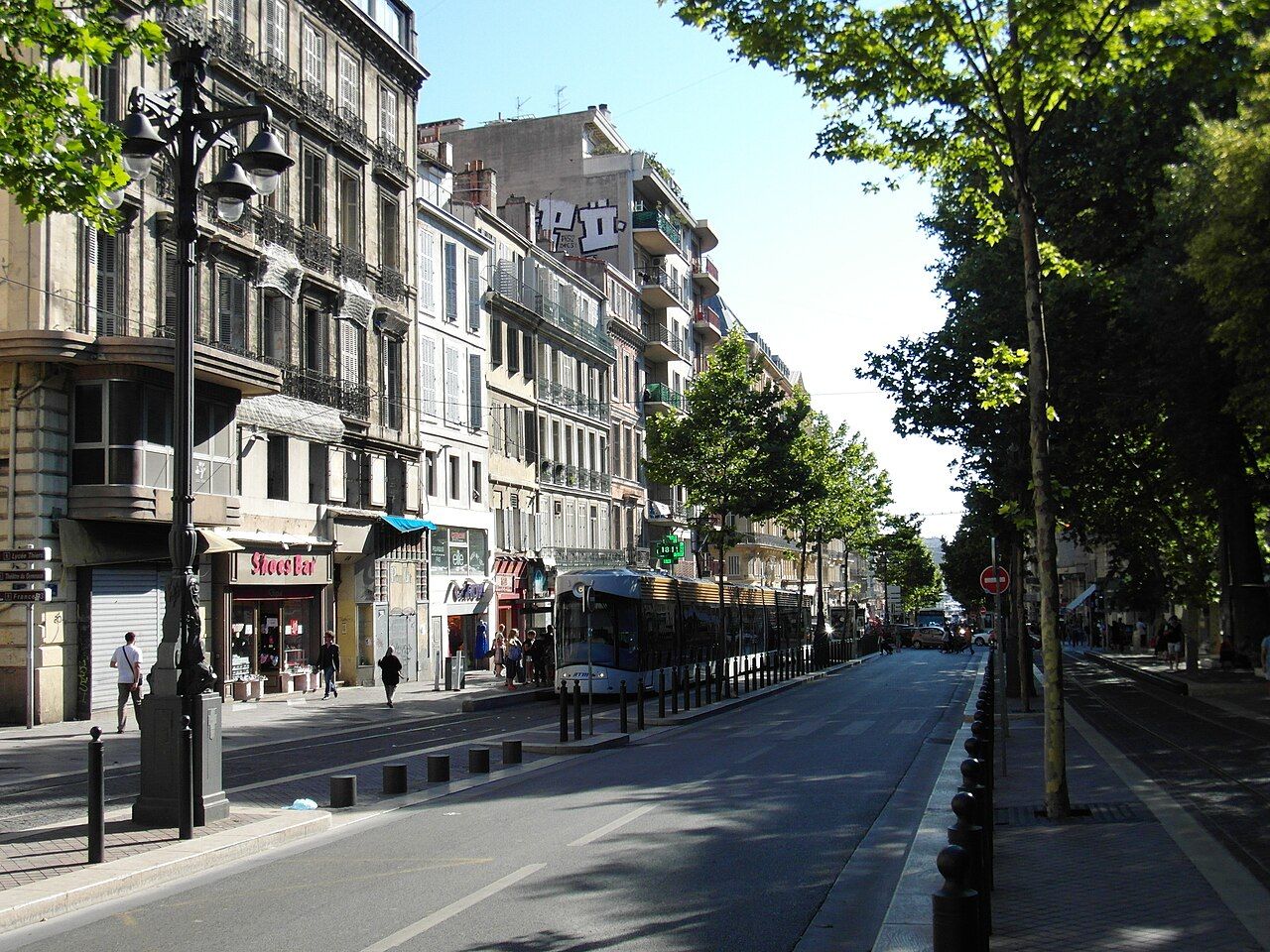
Trams have run along the Canebière again since 2007. The return is the clearest marker of change in the street’s recent story. It places tram movement back into the avenue’s account, alongside the longer-established harbour-to-church route. The fact is enough: the trams are back, and the Canebière is again a route they run along.
 Photograph: photographer unknown — PD original

Metro line 1 also runs under the Canebière, with stations at Vieux-Port and Noailles. Above ground, the avenue can be followed from the quay towards the Réformés; below it, the two stations mark either end of a useful stretch. I like having those two ways of understanding the route together: as a walk across the city and as a line with points beneath it.
7. The church at the top
At the eastern end stands the neo-Gothic church of Saint-Vincent-de-Paul, known locally as the Réformés. The name used in conversation is shorter than the full church name, and it gives the avenue a definite finish. From the head of the Vieux-Port to the Réformés: about a kilometre, with the lower stone buildings, the Cours Saint-Louis, the Bourse and the tram route along the way.
The church is the endpoint of this walk, but the Canebière does not reduce to a single view or a single date. Its name, public route and buildings each carry a different history.
8. Route notes
Follow the avenue from the harbour east towards the church. The lower Canebière carries the carved stone facades, the Palais de la Bourse and the Cours Saint-Louis. The street then continues to Saint-Vincent-de-Paul, the Réformés. Metro line 1 has stations at Vieux-Port and Noailles, and trams have run along the avenue again since 2007.
| Route | From the head of the Vieux-Port east to Saint-Vincent-de-Paul |
|---|---|
| Length | About a kilometre |
| Metro | Line 1; stations at Vieux-Port and Noailles |
| Trams | Running along the Canebière again since 2007 |
The best part is the way the avenue keeps several histories in view at once.