Entry013
La Major: green and white stone above the docks
A day beside La Major, where green and white stone, domes and towers stand next to the smaller Romanesque cathedral they displaced.
- Place
- Cathédrale de la Major
- Arrondissement
- 2nd
- From the Quai des Belges
- 15 minutes on foot
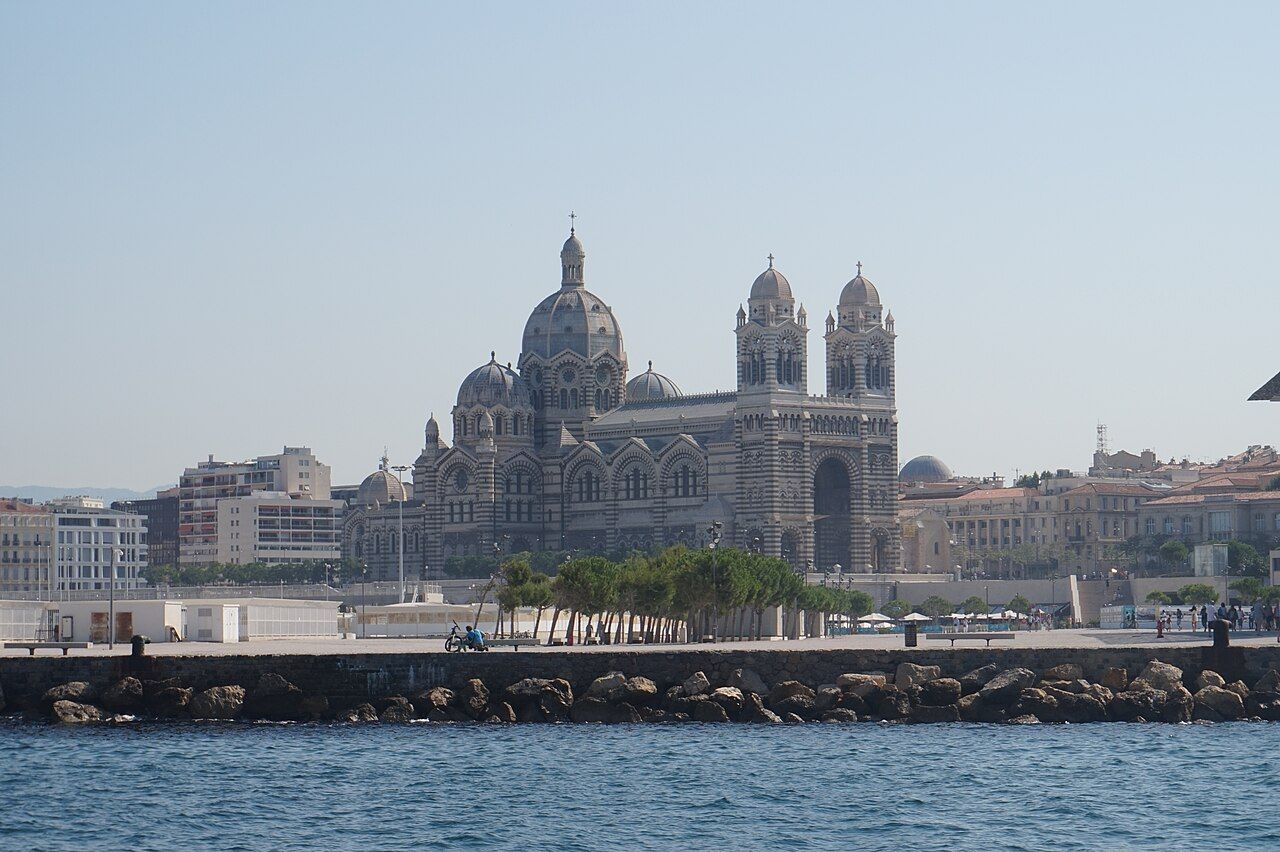 Photograph: Olena Ilnytska — CC-BY-SA-4.0
1852. Morning approach
What sets the scale of La Major before anything else? Its position, on the western edge of Le Panier, looking out to the port and sea. The cathedral faces the sea from a place where those two parts of Marseille meet. Coming from the port takes 15 minutes on foot. I start the day with the name: Cathédrale Sainte-Marie-Majeure, usually called La Major.
It is a cathedral built over a long span, between 1852 and 1893. Napoleon III laid its first stone in 1852. That is a beginning worth keeping in mind while looking at the completed building: a large undertaking, not a single moment of construction.
1893. The long view
La Major was designed by Léon Vaudoyer and finished by Henri-Jacques Espérandieu. Its style is Romano-Byzantine, with domes and towers. The form is not shy about its size. At about 142 metres long, it is among the largest cathedrals built in France in the 19th century.
The length is easier to take in as a fact than as a single view. I find myself measuring it in parts: the rising forms of the domes and towers, then the broad stretch of the building. Nothing needs adding to explain the scale. The figures and the stone do that work.
142. Green and white
The walls are banded with green stone from Florence and white stone from Calissanne. The bands are the detail I keep returning to. They make the mass legible without making it feel small; the eye can follow the change of stone while the whole building holds its place above the port.
There is a plain pleasure in having a clear detail to look at. Green, then white; one material alongside another. I continue along the building, still thinking about how much wall those bands cover.
19th. Beside the older cathedral
The smaller Romanesque former cathedral, the Vieille Major, stands beside La Major. It was partly demolished to make room for the new cathedral. The two buildings make the change in scale immediate: old beside new, small beside huge. The older one remains alongside it, part of the view as well as La Major’s history.
The comparison gives the day a useful pause. The newer cathedral has its long reach and patterned stone. The Romanesque one gives that size a neighbour.
2. Afternoon on the esplanade
The esplanade looks out over the Joliette basins and the sea. From here the setting pulls the building back towards its position between the port and Le Panier. In the view are the cathedral, the basins and the water beyond; the eye can move from the green and white walls to the open outlook. From the esplanade, the view takes in the long warehouses on the basins below and the sea.
La Major is the cathedral of the Archdiocese of Marseille. That name belongs with the building’s purpose, but my attention keeps shifting between its place in the city and its surfaces. The stone bands make the cathedral readable from the esplanade without taking away its size.
15. Evening return
By evening, I have come back to the same few facts: a cathedral built between 1852 and 1893; a design by Léon Vaudoyer, finished by Henri-Jacques Espérandieu; green stone from Florence and white stone from Calissanne. The route through the day has been a route through scale, from the port-side position to the walls, and then to the smaller Romanesque building beside them.
The view over the basins and sea is a fitting last stop. La Major faces the water, but the older cathedral beside it keeps the story close to the ground. I leave with the bands of stone still in mind.
| Position | Western edge of Le Panier, facing the sea |
|---|---|
| From the port | 15 minutes on foot |
| Arrondissement | 2nd |
I prefer the view from the esplanade, where the stone and the sea share the frame.