Entry051
How La Marseillaise got its name
Start on Rue Thubaneau, where Marseille’s volunteers gathered, then follow the song they carried to Paris and the name Parisians gave it.
- Place
- Rue Thubaneau
- Arrondissement
- 1st
- From the Quai des Belges
- 10 minutes on foot
 Photograph: Ji-Elle — CC-BY-SA-3.0
1. The song’s first title
Begin with the title Rouget de Lisle gave his song: he called it a war song for an army. He wrote it in Strasbourg in April 1792. The name La Marseillaise came later, and not from the place where the song was written. That distinction is the useful first step in following its route. The song began in one city; its familiar name was attached to it somewhere else.
2. Set the route in order
In the summer of 1792, a battalion of about five hundred volunteers marched from Marseille to Paris. They sang Rouget de Lisle’s song along the road, then sang it in Paris. Keep those two parts together: the march carried the song beyond Marseille, and the singing in Paris made the volunteers recognisable through it. The name followed the people who brought the song, rather than the man who wrote it or the army named in his first title.
3. Start at the gathering place
For the Marseille end of the story, go to Rue Thubaneau in the Belsunce quarter. The volunteers had met in a hall on this street. The street is the small, specific starting point: not a vague point on a map of the city, but the place tied to the group before its march north. The Rue Thubaneau runs between the Cours Belsunce and the Rue d’Aix. That gives the story a clear line to follow on foot.
It also helps keep the sequence straight. The volunteers gathered here; Rouget de Lisle wrote the song in Strasbourg. They are connected by what happened afterwards, not by the place of composition.
4. Follow the singing, not just the march
Trace the song through the volunteers’ voices. They sang it on the road from Marseille and in Paris. The move from one setting to the next matters: the song travelled with them, and its sound became associated with the people who sang it. The grand avenue a block south offers a different scale for thinking about the city’s streets, but Rue Thubaneau keeps this part of the account close to its gathering place: the grand avenue a block south.
Parisians named the song after the volunteers from Marseille who sang it. That is the central turn in the story. La Marseillaise is a name formed by a journey and a group, not the title Rouget de Lisle first chose.
5. Put the Paris events after the name’s journey
The volunteers reached Paris at the end of July 1792. They took part in the storming of the Tuileries on 10 August. Keep these events in their place in the sequence: the march and the singing had already carried the song into Paris, where Parisians named it for the Marseille volunteers. The later events give the volunteers a place in the city’s history, but the name itself points back to their singing.
In 1795, La Marseillaise was declared the national song of France. The name that began with the volunteers had become the name of the national song.
6. Finish back on Rue Thubaneau
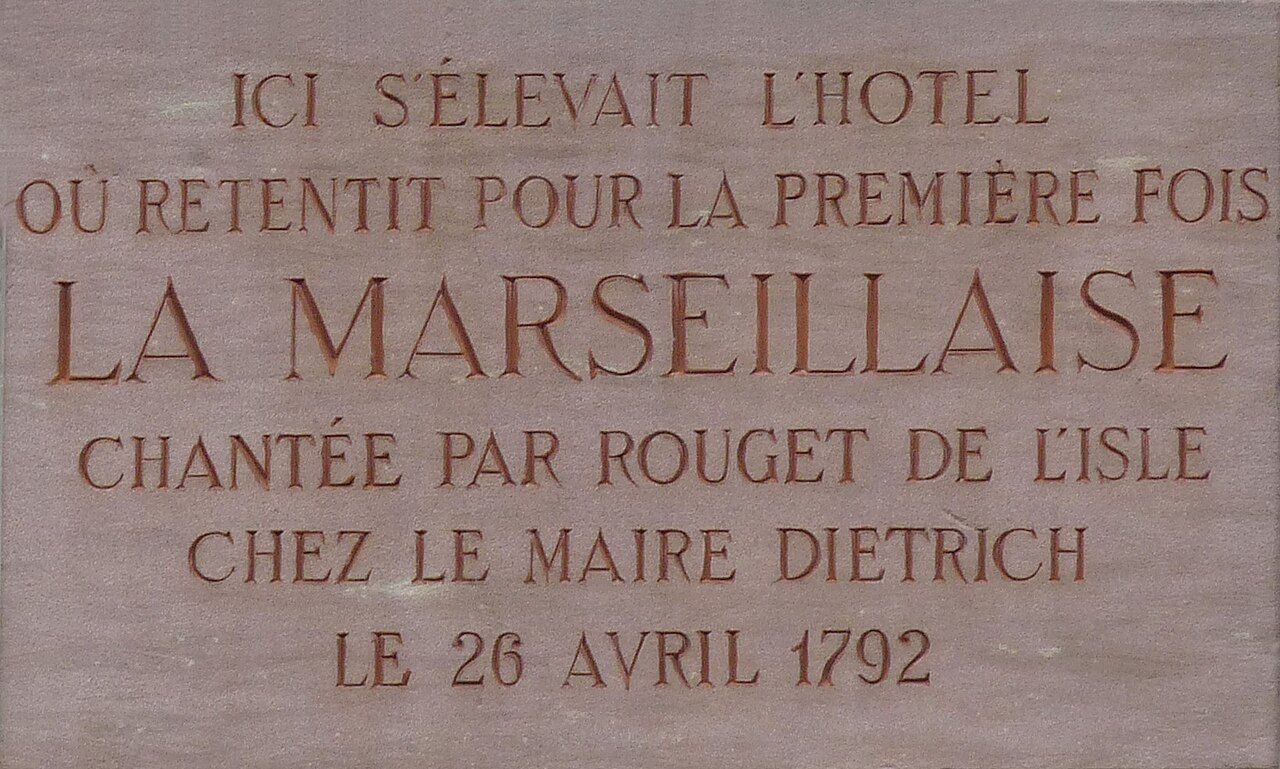
A memorial to La Marseillaise opened on Rue Thubaneau in 2011. Return to the street in the mind’s version of the route: a hall where the volunteers met, then a song carried away from Marseille, then a name given in Paris. The memorial brings the story back to its local beginning.
I like this route best in its simplest form: one street, one march, and a name that remembers the singers.
| Place | Detail |
|---|---|
| Rue Thubaneau | In the Belsunce quarter |
| Rue Thubaneau | Runs between the Cours Belsunce and the Rue d’Aix |