Entry024
Palais Longchamp: the canal behind the fountain
A palace built to mark Durance water reaching Marseille. Follow the canal’s story from the central fountain into the art and natural history collections in its wings.
- Place
- Palais Longchamp
- Arrondissement
- 4th
- From the Quai des Belges
- metro line 1, then 5 minutes
 Photograph: kallerna — CC-BY-SA-4.0
1. What was the city waiting for?
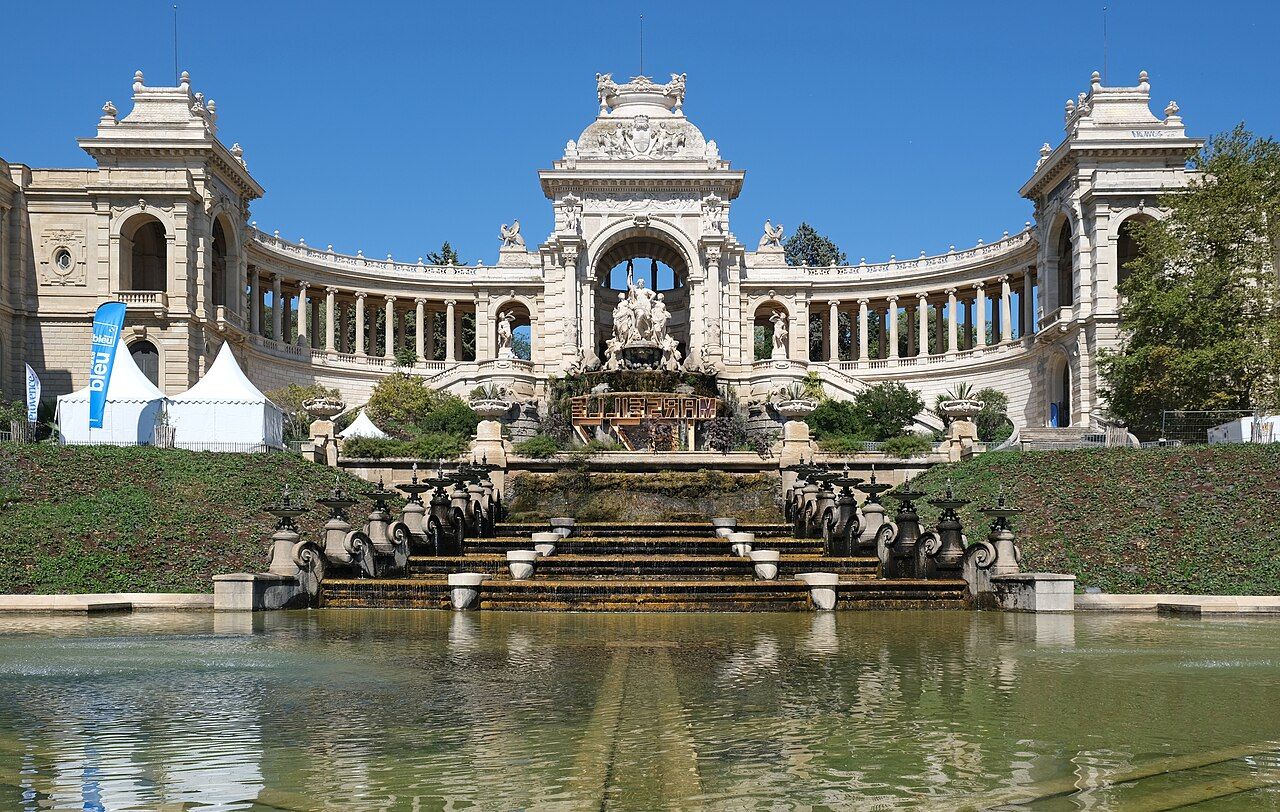
What does a palace celebrate when its subject is water? At Palais Longchamp, the answer is gathered around the central fountain and the colonnaded building. The palace marks the arrival of water from the river Durance, carried to the city by the Canal de Marseille. Water is the reason for the place, not a detail added to it.
The canal was designed by the engineer Franz Mayor de Montricher. It brought Durance water to Marseille from 1849, after droughts and cholera epidemics struck the city. That history gives the palace its starting point. The fountain does more than decorate the space before the museums: it gives the canal story a set of figures to look at and consider.
2. The route and the building
The Palais Longchamp was built between 1862 and 1869 to designs by Henri-Jacques Espérandieu. The canal had already begun bringing water to the city. First came the route; then a palace to celebrate the arrival. The building draws the eye towards its centre, where the fountain makes an engineering story public and visible.
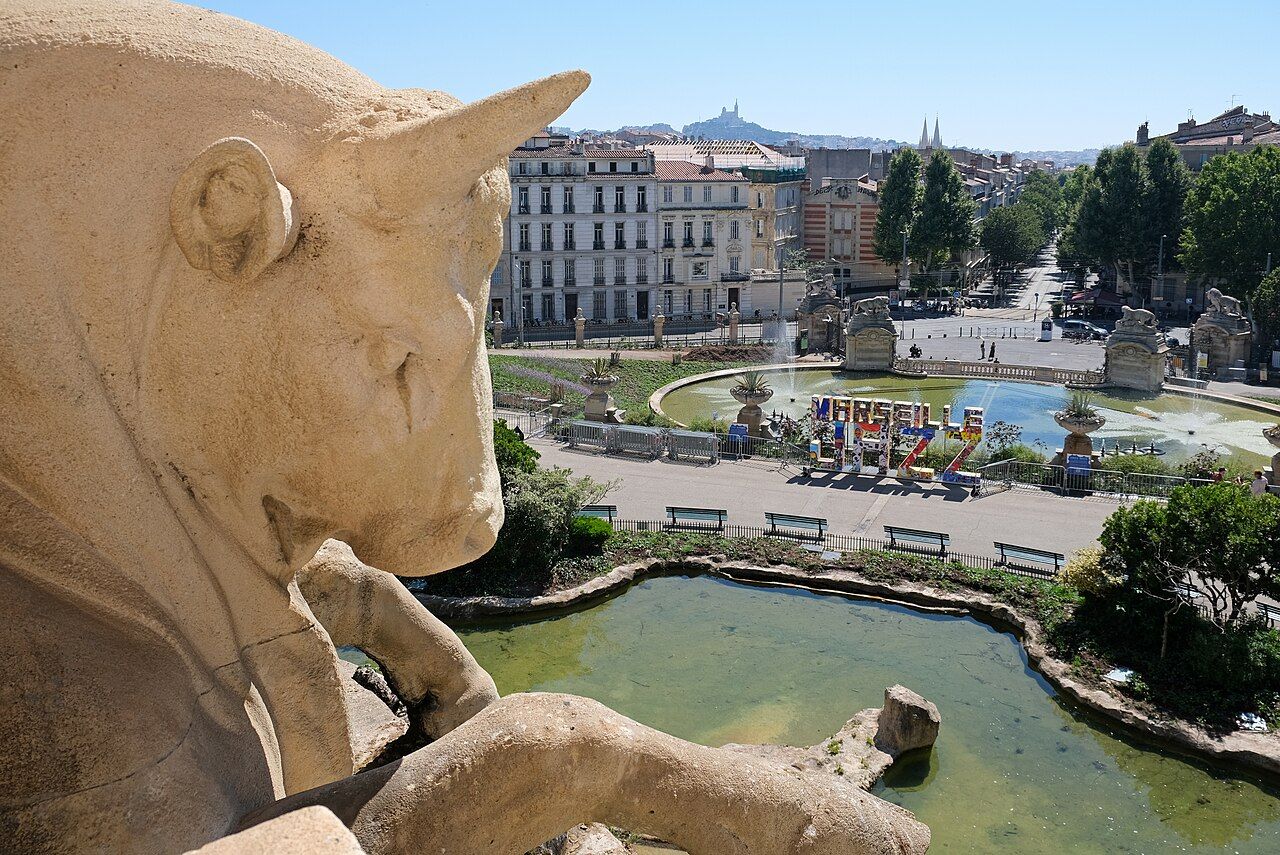
The canal itself is represented through a group of figures. The Durance appears as a woman, flanked by figures of wheat and the vine, drawn by bulls. River, crops and animals meet in a single composition. It is an image of water and what it can bring, rather than a diagram of how the canal works. The canal is the story the palace keeps at its centre.
The canal is the story the palace keeps at its centre.
3. Reading the fountain
The fountain is worth taking slowly. The Durance is given a human form; wheat and the vine stand beside her; bulls draw the group. Each element is named in the composition, so the idea can be read without turning away from the central figures. The canal’s practical history and the fountain’s image sit together, without being the same thing.
I prefer to begin with the figures, then bring the canal back into mind: designed by Franz Mayor de Montricher, carrying water from the Durance to Marseille from 1849, and built after droughts and cholera epidemics. The palace makes more sense with that sequence in view. It gives a city’s need for water a public shape.
4. The left wing
The Musée des Beaux-Arts occupies the left wing. Its collection includes sculpture by Pierre Puget and works by Honoré Daumier, who was born in Marseille in 1808. The museum has its own focus beside the fountain’s account of water. Outside, the palace gathers attention at its centre; inside this wing, art carries the visit forward in another direction.
The Musée des Beaux-Arts reopened in 2013 after a long renovation. The building’s life therefore includes its original purpose as a celebration of water and its later role as a home for collections. I like the shift between the grouped figures outside and the works inside. The fountain gives the site a central thread, but it need not be the only thing to hold attention.
 Photograph: kallerna — CC-BY-SA-4.0
5. The right wing
The Muséum d'histoire naturelle de Marseille fills the right wing. The Musée des Beaux-Arts sits to the left, the natural history museum to the right, and the fountain holds the centre. That arrangement gives the palace a clear shape: one building, two museums, and the water story that explains why it was built.
Across the boulevard, a collector's house across the boulevard offers another point of interest beside the paired wings. Here, though, the movement between the fountain and the collections is enough to keep the visit varied. I find it useful to return to the central figures after spending time in either museum. They bring the canal back into view.
6. The ground behind
A public park climbs behind the Palais Longchamp, on the site of the former city zoo. The slope extends the setting beyond the building, and I prefer to continue uphill for a little before looking back. The palace then reads as one whole: its central fountain, its wings and the park rising behind it.
The Observatory of Marseille moved to the Longchamp plateau in the 1860s. This is another strand in the site’s history, separate from the canal’s route and the museum collections. The palace celebrates Durance water; the park occupies the former zoo site; the observatory moved to the plateau. Keeping those details distinct makes the place easier to understand.
7. The canal, then the collections
A useful order is to begin at the fountain. Look at the woman representing the Durance, the figures of wheat and the vine, and the bulls drawing them. Then follow the history behind the image: the Canal de Marseille was designed by Franz Mayor de Montricher and brought Durance water to the city from 1849, after droughts and cholera epidemics. The palace followed, built between 1862 and 1869.
From there, the wings offer two separate collections: the Musée des Beaux-Arts, with sculpture by Pierre Puget and works by Honoré Daumier, and the Muséum d'histoire naturelle de Marseille. The public park behind gives the visit room to continue. Tram line T2 and metro line 1 both stop close to the Palais Longchamp.
| Detail | Information |
|---|---|
| Area | 4th |
| From the port | Metro line 1, then 5 minutes |
| Nearby transport | Tram line T2 and metro line 1 stop close |