Entry014
Le Panier on foot: from the quay to the windmills
A climb from the quay to Place des Moulins follows steep stairs, old street lines and small squares through Marseille’s oldest quarter and its layers of settlement.
- Place
- Le Panier
- Arrondissement
- 2nd
- From the Quai des Belges
- 10 minutes uphill
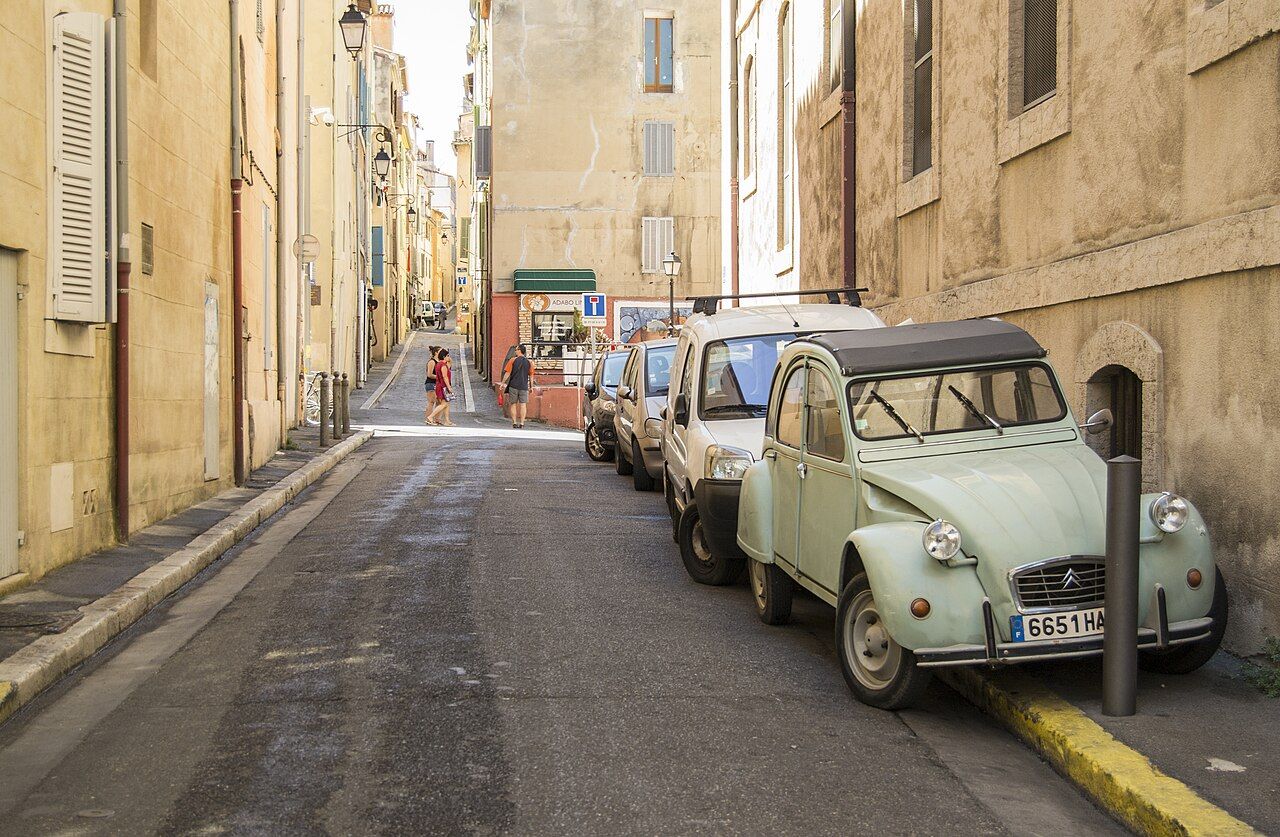 Photograph: Lily from Tallinn — CC-BY-2.0
“Le Panier is the oldest quarter of Marseille.”
1. Start at the quay
Le Panier sits on the hill north of the Vieux-Port, on the site of the first Greek town of Massalia. It is the oldest quarter of Marseille. From the quay, the direction is uphill, but the old lanes do not begin straight at the water. The lower part of Le Panier was flattened in 1943, so the older streets now start some way above the quay. There is a stretch between harbour and hill before the climb reaches them.
The change in level is easy to feel. Le Panier is not a level grid to cross in a glance. Its stairways rise from streets behind the Quai du Port, and the walk gathers height as it goes. The hill sets the pace; the squares and lanes come into view along the way.
The hill sets the pace; the squares and lanes come into view along the way.
2. Take the older line uphill
The Grand-Rue follows one of the oldest street lines in Marseille, running from the harbour towards the hill. It gives the route a clear direction: away from the quay and into Le Panier. The street line and the slope meet here. A walk along it is a straightforward way to register how the harbour and higher ground are joined.
Steep stairways such as the Montée des Accoules climb from the streets behind the Quai du Port. The steps make the ascent immediate. At the Montée des Accoules, the route passes a lone bell tower in a small square, before continuing upwards. I prefer this kind of climb to a route that hides its effort; here, the hill is plain underfoot.
3. Pause at Place de Lenche
Place de Lenche is often said to lie close to the site of the agora of Greek Massalia. The wording matters: close to the site, and often said. It connects the square with the early town without making a stronger claim than the account allows. The place sits within a quarter whose history reaches back to that first Greek settlement.
At this point, the walk can hold two ideas together: the streets and stairs of the present, and the Greek town associated with the hill. Place de Lenche makes a natural pause in the climb. Then the route continues through lanes where the present is close at hand: walls, pots, doorways and washing overhead.
4. Read the lanes as they are
Painted walls, murals and plants in pots fill the lanes of Le Panier. They are encountered at street level, around turns and along the narrow passages. No single wall or pot needs to stand for the whole quarter. Together, these details are part of its everyday appearance, beside the older street lines and the work of climbing them.
Washing hung across the narrow streets is still a common sight. It draws the eye above the walking line and makes the closeness of the lanes clear. The streets are routes through the quarter, but they are also part of its daily life. I like that the walk leaves room for both readings: the hill as a way through, and the small details that belong to the lanes themselves.
5. Keep the layers in view
The history of Le Panier is not only the history of its ancient origins or its oldest streets. Corsican, Italian and later North African families have each made the quarter their home over the last two centuries. Set beside the first Greek town of Massalia, those later communities form further layers in the story of the hill.
That makes age an incomplete description of the place. The street lines and stairways are part of the account, but so are the people who settled here. The families do not need to be folded into a single story. Their successive presence is one reason the quarter cannot be reduced to its earliest past.
6. Climb towards Place des Moulins
Near the top of Le Panier, Place des Moulins takes its name from the windmills that once stood there. The square gives the uphill route a clear destination, and the name keeps a trace of what occupied this part of the hill. From the quay, the climb has moved through the street lines and stairways towards this higher ground.
The squares break up the ascent. The lanes turn and narrow; the steps make the height unmistakable. I prefer to take the climb in sections, letting each small square mark a pause before the next stretch. Place des Moulins is a fitting point to stop and look back at the direction of the walk, from harbour towards hill.
7. Let the walk stay about the hill
Le Panier is almost entirely closed to through traffic. On foot, the stairs, lanes and squares become the route rather than details beside it. The lower lanes begin above the quay; the Grand-Rue follows an old line from the harbour; the Montée des Accoules climbs into the quarter. Each gives a different way to understand the same rise in the ground.
The names and places also hold different depths of time. Place de Lenche is often said to be near the agora of Greek Massalia; Place des Moulins recalls windmills that once stood near the top. Between them are the homes made by Corsican, Italian and later North African families, as well as the painted walls, pots and washing of the present-day lanes. The quarter carries these layers without resolving them into one period.
8. The walk in brief
From the quay, head uphill towards the old lanes, which begin some way above the waterfront. Follow the Grand-Rue’s line towards the hill or take the steep stairways behind the Quai du Port. Pause at Place de Lenche, then continue towards Place des Moulins near the top. The streets are almost entirely closed to through traffic, and the climb is the clearest thread through the walk.
For me, Le Panier reads best as a succession of slopes and pauses, with the history held in the streets rather than set apart from them.
| Arrival | 2nd |
|---|---|
| From the port | 10 minutes uphill |